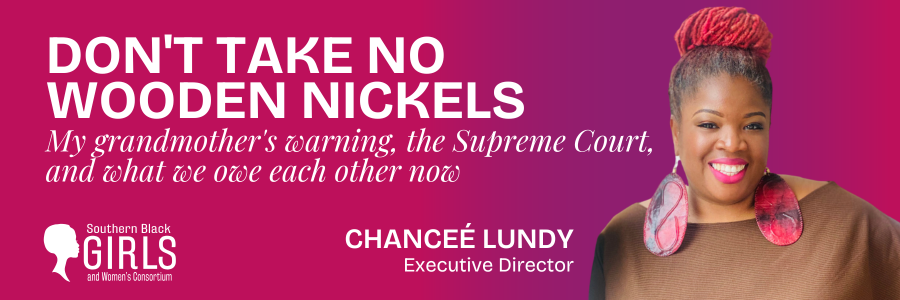
Don’t Take No Wooden Nickels
My grandmother’s warning, the Supreme Court, and what we owe each other now
Chanceé Lundy, Executive Director
Hey girl hey,
My grandmother would often tell me, “Chanceé, don’t take no wooden nickels”. It was her way of warning me not to let anyone give me something with perceived value that had no value at all. Now when she said it, she was mostly referring to them “lil boys” telling me what I wanted to hear; but, I’ve found the value in this wisdom in so many other areas of my life. For example, this recent decision by the Supreme Court. On April 29, 2026, the United States Supreme Court ruled 6-3 in Louisiana v. Callais to strike down a congressional map that gave Louisiana a second majority-Black district. The decision guts Section 2 of the Voting Rights Act, the provision that has, for sixty years, given Black voters legal recourse against maps drawn to dilute our power. Justice Kagan, in dissent, wrote that the ruling renders Section 2 “all but a dead letter”. This decision hollows out the spirit, intent and enforceability of the Voting Rights Act so that it no longer has any value.
Sistas, I want to speak plainly to you about this.
The DNA of my family is on the Edmund Pettus Bridge. As I always proudly proclaim, I am from Selma, Alabama. The Voting Rights Act was forged on a bridge that I saw every day. It remains a reminder of what happened on March 7, 1965, when Black people, in the words of Fannie Lou Hamer, were “sick and tired of being sick and tired.” The beatings, the dogs, the tear gas that hundreds, including children such as my mama and aunts, endured so that this country might honor the most basic premise of democracy: that every citizen has the right to vote. These foot soldiers, some whose lives were lost, did it so that their generation and future generations could have this right without burden and restriction. Selma wasn’t the only place that endured this brutality. Thousands across the South gave their all to make this a reality through the Civil Rights Movement.
What the Court did last week is not just a legal ruling. It is a deliberate unwinding of a debt this country has yet to pay to our people. Louisiana is one of the thirteen states where Southern Black Girls works. So is Alabama. So are the states where this ruling will now invite legislators to redraw maps that erase Black political power under the cover of partisanship. The communities hit first and hardest will be the ones we serve every day: Black girls, Black women, and the families that hold our region together. This ruling will have consequences nationally and locally where some of the most oppressive policies are taking shape.
Let me say this. We are not surprised, and we are not unprepared. The work of Southern Black Girls has always been about the long arc, the strategy that outlasts any single ruling and any single court.
We continue to direct resources to the organizations on the ground. We continue to unapologetically invest in the leadership of Black girls and women across the South. We continue to insist, as we have from the beginning, that joy is not a luxury. Joy is strategy. Joy is the proof that we are still here, still building, still claiming a future no court can vote down.
To every Black girl reading this: your voice matters. Your future matters. The people who came before us left their DNA on the bridge but it also lives within us. We will cross this bridge together because – we ain’t going back!
In solidarity and in love,
Chanceé Lundy
Executive Director
Southern Black Girls and Women’s Consortium